Boards are expected to understand a fast-growing body of AI rules and standards. Today we are publishing a set of visual guides that show the whole landscape at once, built around the questions directors actually ask.
Key takeaways
- Our Regulations & Standards page is now a set of visual guides, not a list of laws.
- Each guide answers one question a board asks: where rules apply, who they bind, how fast an incident escalates and what the board will be measured against.
- Every guide can be downloaded, linked directly or shared on LinkedIn.
- A companion Standards page explains NIST AI RMF, ISO/IEC 42001 and the other benchmarks, with questions for management.
Why did we build visual guides?
AI rules now arrive from many directions at once: the EU AI Act, US federal agencies, a growing number of US states, Asia-Pacific regulators and voluntary standards that courts and insurers treat as benchmarks. Boards usually receive this as a long memo, organised by jurisdiction.
The questions directors actually ask are different. Which of these reach us? Which duties are ours, and which belong to our vendors? If something goes wrong, how much time do we have? What would good evidence of oversight look like? Those questions are easier to answer when you can see the whole landscape at once.
What is in the guides?
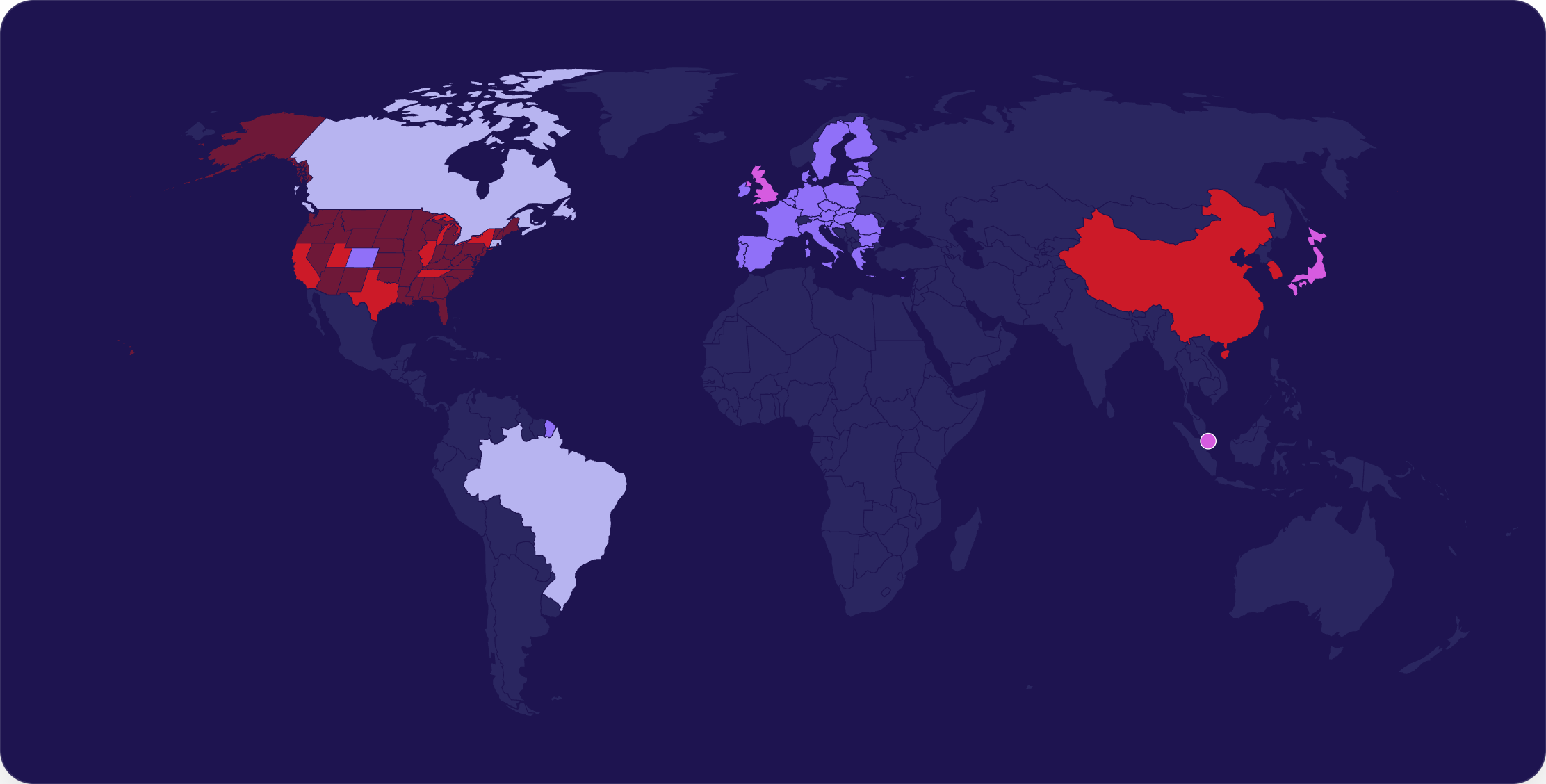
- Where AI rules apply A world map shaded by status, with individual US states. In force, coming, voluntary and proposed are shown in one view.
- How many rules reach your company Choose public or private, where you operate and what your AI touches. The count updates by region.
- Duties by role Developer, deployer, public company and employer. Most companies play more than one role.
- Region against region Compare two regions on transparency, fairness, incident reporting, penalties, scope and personal accountability.
- Inherited exposure Most AI arrives through suppliers. Each layer, from cloud to agents, comes with a question for the board.
- The incident clock From AI incident to disclosure, regulators, litigation and D&O, with the time windows at each step.
- What helps and what hurts in court The oversight habits that lower exposure, set against the ones that raise it.
- The evidence pyramid Principles are easy to state. The record is hard to produce.
- Four moves for the next 12 months Inventory, owner, policy and rehearsal, and the evidence each one leaves.
Where a guide names a law or standard, the name links to the official source or to our Standards page, which explains what each benchmark asks of a board.
How can a board use them?
We designed the guides to be taken into the boardroom. A committee chair can download the incident clock for a risk committee discussion. A general counsel can link the duties-by-role guide in a pre-read. A director preparing for an AI approval can check how many rules reach the company before the meeting.
They work best as a starting point for questions to management, not as a conclusion. Each guide is a summary, and whether a rule applies to a particular company depends on the facts.
What comes next?
We will keep the guides current as rules change, and add new ones as boards ask for them. Measured data from the Vela Barometer will replace our own estimates where the guides use them, starting with where common oversight practices sit today.
If there is a question your board keeps asking about AI regulation, tell us. It may become the next guide.
Common questions
Are the guides free to use?
Yes. Every guide on the Regulations & Standards page is free. Each one can be downloaded as an image, linked directly or shared on LinkedIn.
Can we use them in board materials?
Yes, with attribution to Vela Board Advisors and a link to velaboards.com/regulations. They are summaries, so pair them with advice from your counsel.
How current are they?
We review the page as rules and standards change. The date at the top of the page shows the last update.
Do the guides replace legal advice?
No. They show the shape of the landscape. Whether a rule applies to your company depends on the facts, and that is a question for counsel.