Fire drills exist because the first time shouldn't be the real thing. The same logic applies to AI governance decisions. Almost no board has run the drill.
A hospital runs a mass casualty exercise before a mass casualty event. A bank runs a liquidity stress test before a liquidity crisis. A utility runs a grid-failure simulation before the grid fails. In every high-stakes domain where the cost of an unscripted first response is catastrophic, the standard practice is to practice before the real thing happens.
Boards are not treated this way. For all the governance frameworks, all the oversight obligations, all the fiduciary responsibilities that rest with directors, almost no board ever practices the decisions it will eventually be called on to make.
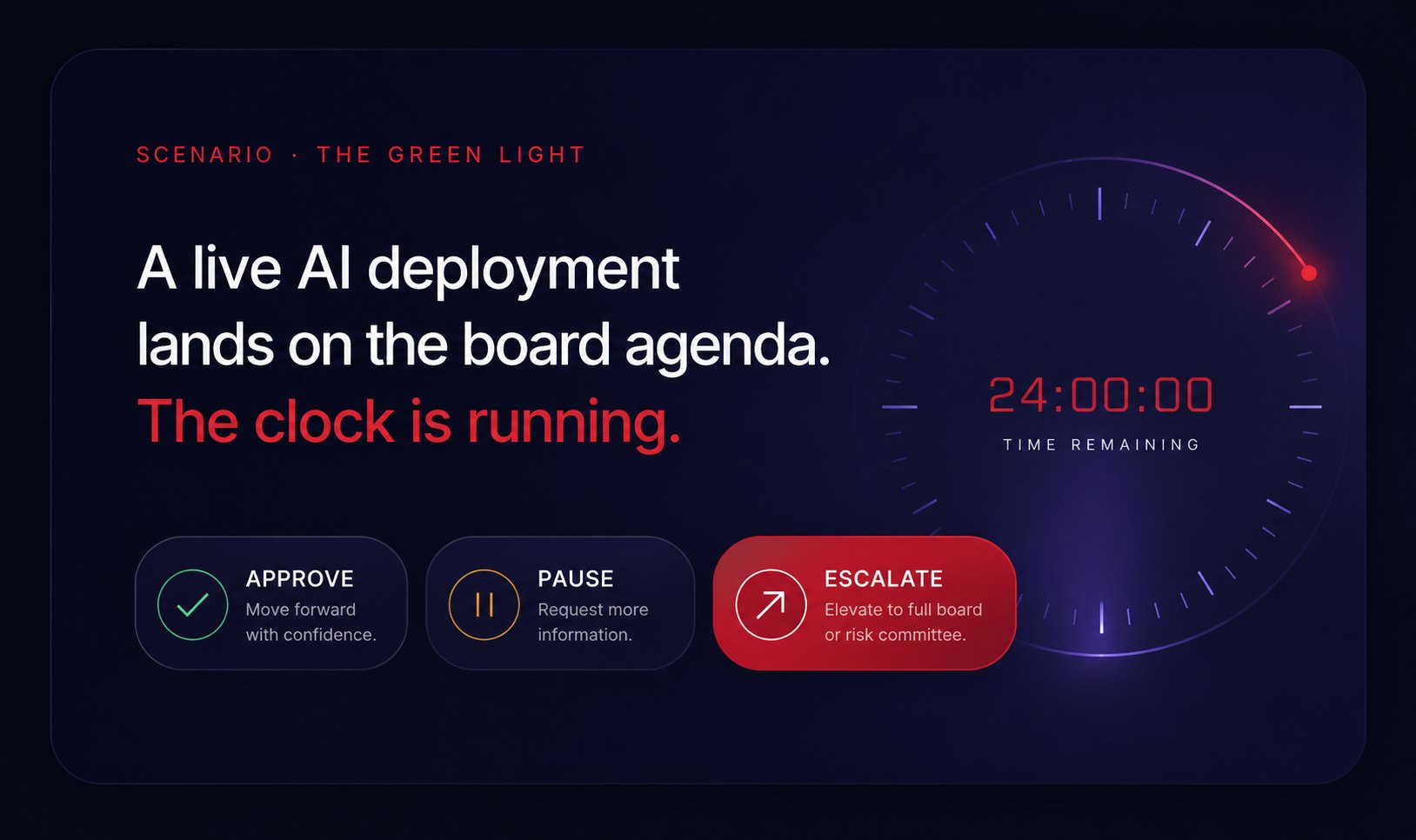
That gap is wide enough in traditional governance domains. In AI governance, where the decisions are new, the stakes are high, and the cognitive frameworks do not yet exist, it is potentially damaging.
What a First Response Without Practice Looks Like
Consider the scenario. An AI system deployed by the company has made a sequence of decisions that harmed a class of customers. The incident is surfacing publicly. Management is in the room. Counsel is on the phone. The board needs to make several decisions in rapid succession. About disclosure timing. About system shutdown authority. About coverage implications. About board communication. About what was known and when.
For a board that has never navigated an AI governance decision at any level of formality, this is the first time every cognitive and institutional muscle required for that decision has been activated. That is a difficult condition in which to make decisions that will be scrutinized by regulators, litigants, and insurers for the next several years.
The mistakes made under those conditions tend to be the ones that create director exposure. The coverage assumption that turns out to be wrong. The disclosure that happens too late. The shutdown decision that is not clearly within anyone's authority. Practice prevents these.
What Simulation Specifically Teaches
Governance simulation does not primarily teach facts. It teaches decision-making under uncertainty, which is what governance decisions almost always require. The specific things that well-designed simulation builds:
- Pattern recognition. Directors who have worked through an AI governance scenario before can identify the signals of an emerging issue faster. The cognitive pattern is familiar even when the specific facts are new.
- Question instincts. Knowing which questions to ask about accountability, coverage, escalation authority, and disclosure obligations requires familiarity with the governance framework those questions are drawn from. Simulation builds that familiarity in context.
- Institutional clarity. Many boards discover in simulation that they have not actually established clear authority for AI-related decisions. Who can authorize a system shutdown? Who decides on disclosure timing? Discovering this in a simulation is dramatically better than discovering it during an incident.
- Coverage awareness. The D&O, cyber, and E&O coverage question almost always surfaces in AI governance scenarios. It almost always reveals gaps that boards had not previously noticed. Discovering those gaps in a simulation environment creates time to address them.
The Governance Record Dimension
There is a secondary benefit to documented governance simulation that is worth naming explicitly. It creates a governance record.
A board that can demonstrate it engaged in structured AI governance practice, working through scenarios, identifying gaps, and taking remediation steps, has a materially stronger governance posture than a board with no such record. In the event of a future incident, the difference between "we had run this exercise and identified this type of risk" and "we had not considered this type of risk" is not a small one.
The fire drill exists because the fire is coming. The governance drill exists for the same reason. The only question is whether the first time the board makes an AI governance decision under pressure, it is a drill or the real thing.