Company News
Introducing the Vela Board Navigator℠
Company News
A practical framework for board AI oversight, built around the decisions directors need to make.
Key takeaways
AI is now a standing item on many board agendas. Directors are being asked to understand its strategic implications, challenge management's assumptions, oversee emerging risks, and make decisions that may carry significant legal and commercial consequences.
The expectations are growing. The tools available to boards are still catching up.
JUST Capital research found that only 4% of corporate leaders identify the board or a board committee as having ultimate responsibility for AI governance. Recent findings from our Director, Defined initiative point to another important dynamic: directors are actively looking for better ways to develop their own understanding and bring informed perspectives into the boardroom.
In our research, 42% identified better insight into emerging issues as their greatest need. Another 29% wanted practical tools to help their organizations navigate those issues.
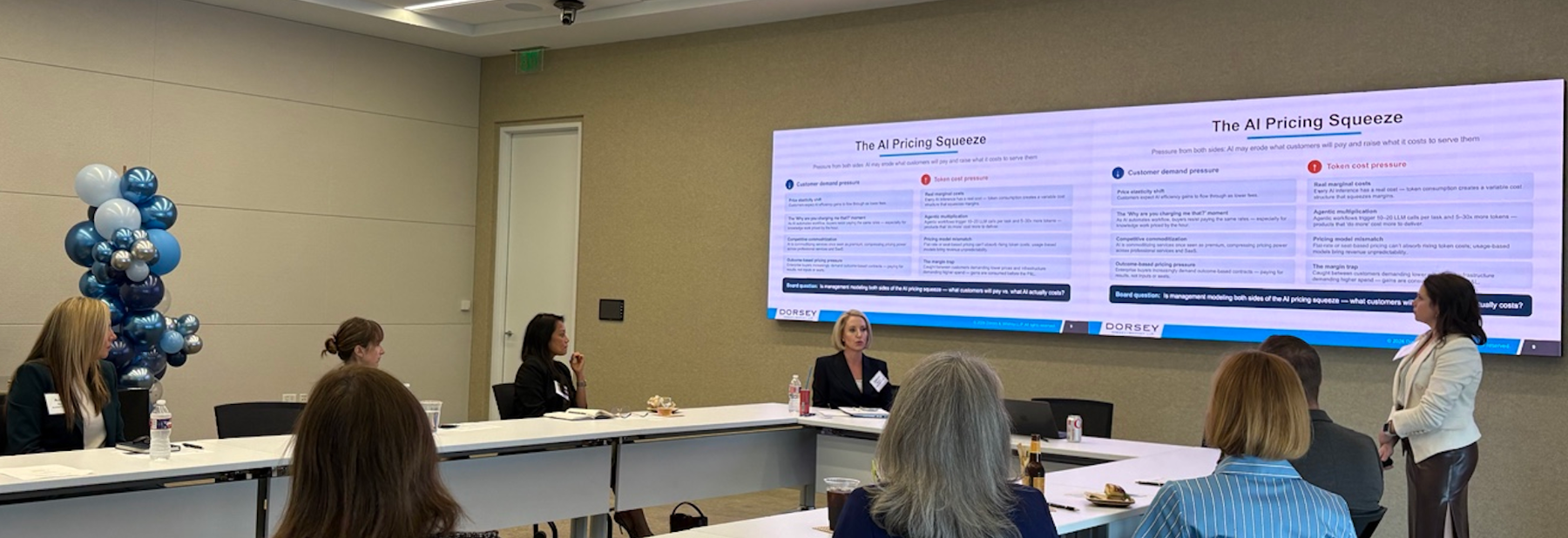
These findings have informed the development of the Vela Board Navigator℠, which we introduced on October 27 at an AI Board Governance Program hosted by Dorsey & Whitney in Dallas.
Earlier this month, nearly 300 directors participated in Director, Defined, introduced with the Private Directors Association at its PRISM Conference.
The assessment explores how directors naturally approach governance, strategy, uncertainty, and boardroom decisions. Several findings stood out.
What directors want most
Where directors start on an unfamiliar issue
Source: Director, Defined, Private Directors Association PRISM Conference, October 2026.
This last finding is particularly relevant to AI oversight.
Directors are being asked to make judgments about technologies that are changing rapidly, sometimes faster than the organization's ability to explain their implications.
They want to arrive at those discussions better informed, ask more meaningful questions, and understand where the board should focus its attention.
That is an important design consideration for any AI governance framework intended for directors.
Our discussion at Dorsey & Whitney brought several practical realities of board AI oversight into sharper focus.
We are operating in a pro-management era. Boards rely heavily on management for information, expertise, and execution. AI introduces new challenges around the level of independent understanding directors need to exercise effective oversight.
AI adoption inside the boardroom remains limited. Many boards are still developing their own familiarity with AI tools, even as they oversee organizations deploying those tools across increasingly important business activities.
Many AI governance challenges are familiar governance challenges. Information quality, accountability, escalation, management challenge, decision rights, and documentation are longstanding board responsibilities. AI makes some of these issues more urgent and exposes where existing practices may need attention.
Jurisdiction influences accountability. Where a company is incorporated can affect directors' duties, legal exposure, and the standards against which their conduct is evaluated. The legal context matters when designing an effective oversight approach.
Boards need room to practice. One of the more interesting discussions concerned discoverability and the reluctance to create records of exploratory board exercises. Directors and counsel want to improve preparedness, but the potential legal consequences of documenting hypothetical decisions can complicate how boards practice.
These discussions reinforced the importance of designing AI oversight around the realities of board operations, including how directors receive information, develop understanding, challenge management, and establish an appropriate record of their decisions.
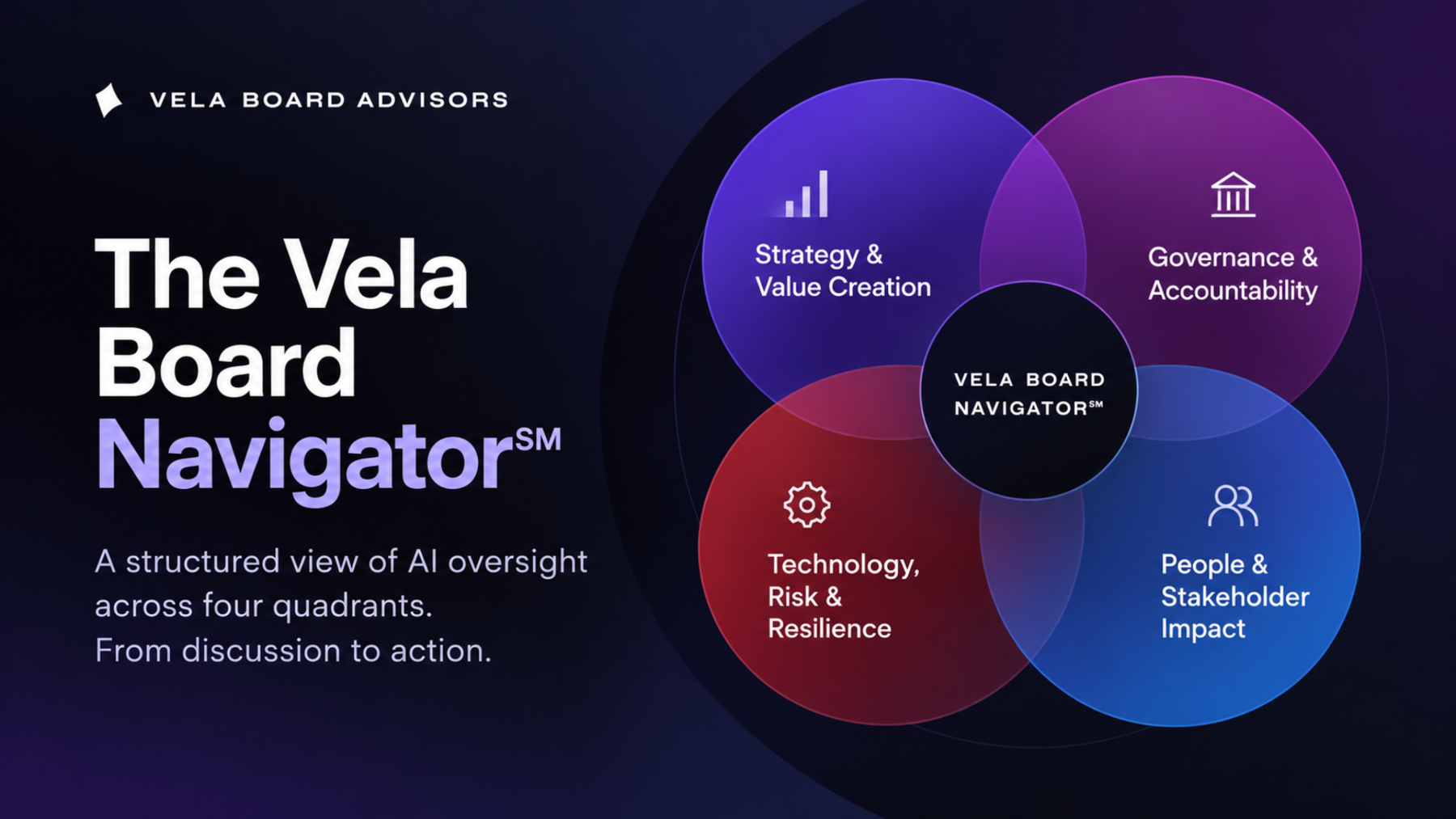
The Vela Board Navigator℠ gives directors a structured way to understand their organization's AI exposure, assess the maturity of board oversight, and identify where further attention is warranted.
It organizes AI oversight into four connected quadrants:
Each quadrant contains four elements, creating a framework of 16 elements of board AI oversight.
Every element is accompanied by a practical test of what the board should be able to demonstrate.
Importantly, the Navigator distinguishes between two considerations that are often combined.
AI exposure: How significantly AI affects the organization's operations, strategy, stakeholders, and risk profile.
Oversight maturity: How effectively the board is governing those matters, from areas where oversight is absent or informal to those where practices are established and evidenced.
These dimensions help boards set priorities in the context of their own organization.
A board overseeing extensive AI deployment will have different oversight requirements from one whose exposure is currently limited. A highly exposed organization with immature oversight may need immediate attention in areas that would be less pressing elsewhere.
The framework is intended to support that judgment.
One of the strongest messages emerging from our work with directors is the importance of turning governance information into insight.
Directors have access to evaluations, maturity models, skills matrices, policies, and governance standards. Each serves a purpose.
The greater opportunity lies in connecting that information to the questions directors actually need to answer.
Where is the organization's AI exposure growing? Which aspects of oversight are sufficiently developed? Where is the board relying on assumptions? What evidence supports its confidence? Which matters deserve time on the next committee agenda?
We have designed the Navigator to help boards work through those questions.
It begins with a short assessment and produces a concise brief that directors can use to guide discussion, identify priorities, and inform the next steps in their oversight program.
As the board's understanding develops, the framework also provides a consistent structure for revisiting those priorities and evaluating progress.
Our broader work at Vela is informed by a simple observation: the value of a governance assessment is ultimately determined by the quality of the decisions it enables.
For AI, that means helping directors build their own understanding, ask better questions, exercise judgment, and demonstrate how oversight is being carried out.
Thank you to Dorsey & Whitney for hosting and sponsoring the AI Board Governance Program, and to the directors who joined us in Dallas for the thoughtful discussion and challenge.
Their perspectives, alongside what we continue to learn from directors across industries, are helping shape the next stage of our work.
Explore the Vela Board Navigator℠ or request a board briefing to explore how the framework could support your board's approach to AI oversight.
The Navigator is where every Vela engagement begins. Request access or a briefing to see what it surfaces for your board.